Aviator (Spribe)
Every Aviator round can be checked, not just trusted. The crash multiplier comes from a server seed, three client seeds and a nonce, hashed with SHA-256 and SHA-512, and it is fixed before the round starts. Here is how the system works and how to verify a result yourself.
Every Aviator round can be checked, not just trusted. The crash point where the plane flies away is locked in by a cryptographic commitment before betting even opens, and after the round you can recompute it yourself and confirm the game did not move the goalposts. That is the whole promise of provably fair. Under the hood it runs on the same hashing family that secures Bitcoin, the return sits at up to 97% with a fixed 3% house edge, and the odds of any target follow a clean rule: the chance of reaching a multiplier of m is roughly 0.97 divided by m.
I have sat and verified rounds by hand, and the first time the numbers lined up it genuinely changed how I felt about the game. So this page does one job: it shows how the system works, step by step, and hands you a way to check a round yourself.
Two things this page is not. It is not a debunk of the "predictor" apps that claim to read the future - that lives on our Aviator predictor and hack page. And it is not the broader is-it-legit verdict, which sits on is Aviator real or fake. Here, we stay on the mechanism.
The commit-and-reveal idea in one minute
Provably fair borrows a trick every kid knows from a sealed-envelope bet. The house writes down the answer, seals it, and shows you the sealed envelope. You add your own scribble to the outside. Only afterward does anyone open it. Because the envelope was sealed in front of you, the house cannot have changed what was inside once your scribble was on it.
In software the "sealed envelope" is a hash. A hash is a one-way fingerprint: feed it any text and it spits out a fixed string that is easy to check but practically impossible to reverse. Aviator publishes the fingerprint of its secret before the round, then reveals the secret after. If the revealed secret produces the same fingerprint, it could not have been swapped mid-flight.
Why a hash is enough
Change a single character of the input and the whole fingerprint changes beyond recognition. That sensitivity is what makes the commitment binding. There is no quiet edit that leaves the fingerprint intact.
How the crash multiplier is actually built
Four ingredients go in, two hash functions do the work, and one number comes out. Here is each piece, in the order the game uses it.
Server Seed
Before the round, the server generates a random secret, a Server Seed of about 16 characters. It does not show you the seed yet. Instead it publishes the seed's SHA-256 hash - the sealed envelope. That published hash is your proof the seed existed and was fixed before you bet.
Client Seeds
Your browser holds a Client Seed too, and so does everyone else's. The round pulls in the Client Seeds of the first three players to place a bet. Because those come from players, not the house, no single party controls the full input. That is the clever bit: the operator cannot pick a seed that suits it, since three strangers are stirring the pot.
Nonce
A Nonce is just the round number, a counter that ticks up so no two rounds share an identical input. It stops a repeat of seeds from ever producing a repeat of results.
The SHA-512 pass
The Server Seed, the three Client Seeds and the Nonce are joined into one string and run through SHA-512. The resulting hash is converted, by a fixed formula, into the crash multiplier - and the 3% house edge is baked into that conversion. Roughly 1 round in 33 is forced to crash instantly at 1.00x, which is where most of the edge comes from.
The plane is already grounded before it takes off
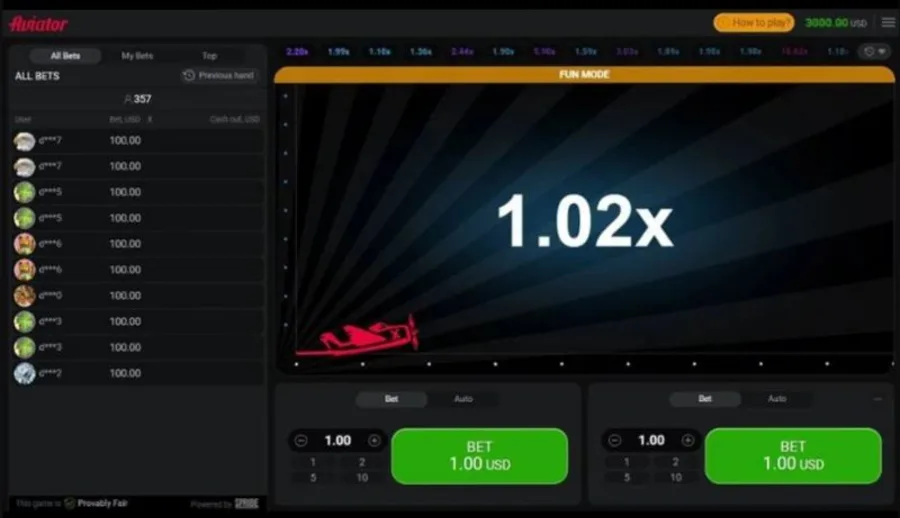
This is the part players find hardest to accept, so I will be blunt about it. By the time the little red plane starts climbing, the number where it disappears has already been decided. The rising curve is animation. It is a dramatic reveal of a result computed a moment earlier, not a live physics simulation that could break your way if you stare hard enough.
Once you internalize that, a lot of folklore falls apart. There is no "hot streak" building in the engine, no pattern in the last ten crashes that leaks the eleventh, and no button-timing trick. Each round is a fresh, independent draw. The history strip along the top is a scoreboard, not a forecast.
Verify a round yourself, step by step
You do not need to code to do a basic check, though a hash tool helps for the full one. Here is the sequence I follow.
1. Grab the commitment
Open the game's Provably Fair or fairness panel before or during a round and copy the published SHA-256 hash of the current Server Seed. Screenshot it so you have it fixed in time.
2. Wait for the reveal
After the round ends, the panel reveals the actual Server Seed, the three Client Seeds and the Nonce for that round. Note them down alongside the multiplier the plane crashed at.
3. Check the seal
Paste the revealed Server Seed into any SHA-256 tool and compare the output to the hash you saved in step 1. If they match, the seed was not swapped after you bet. This single check catches the most important kind of cheating.
4. Recompute the result
Join the seeds and Nonce the same way the game does, run SHA-512, and apply the published conversion to get the multiplier. Match it against what you saw. Most players lean on a community verifier here rather than doing the arithmetic by hand.
Where the verification gets fuzzy
I want to be straight about the limits of all this, because a lot of write-ups oversell it. Spribe publishes the commit-and-reveal machinery and the seed inputs, but it has not laid out every internal detail of the exact multiplier conversion. That means the step-4 verifiers you will find online are mostly community reconstructions of the formula. They match real results, which is reassuring, yet they are not an official reference implementation.
So treat step 3, the SHA-256 seal check, as the rock-solid part - it needs nothing from anyone. Treat step 4 as strong corroboration rather than gospel. That is a fair, honest place to land.
A normal slot RNG
A classic online slot also uses a random number generator, but you cannot see it. Your only assurance is a third-party lab that periodically audits the studio and issues a certificate. You are trusting the auditor, the studio and the calendar between audits. For most players that is fine, yet it is trust, not proof.
Aviator's provably fair
Here you audit the game one round at a time, yourself, with public inputs. Independent labs like GLI, eCOGRA and iTech Labs still certify the RNG, so you get both layers: certification plus per-round verifiability. That combination is genuinely rarer than the marketing around crash games suggests.
What the maths says about your chances
Fairness and profitability are two different questions, and it is worth pinning the numbers down. The probability of the plane reaching a multiplier of m is about 0.97/m, so a cautious 1.5x lands far more often than a greedy 10x. Below is that rule made concrete.
| Target multiplier | Approx. chance it is reached | Expected result per $1 |
|---|---|---|
| 1.20x | about 81% | -$0.03 |
| 2.00x | about 48% | -$0.03 |
| 5.00x | about 19% | -$0.03 |
| 10.0x | about 9.7% | -$0.03 |
| 100x | about 0.97% | -$0.03 |
Notice the last column. Whatever target you pick, the long-run expectation is the same small loss, because the 3% edge rides along on every choice. Chasing a bigger number does not improve your edge; it only swaps frequent small wins for rare big ones.
Fair does not mean winnable
This is the honest downside, and it deserves its own heading. Provably fair proves the game is not cheating you. It says nothing about whether you come out ahead, and over time you will not. The 3% house edge is fixed, verifying a round never nudges your odds, and no amount of seed-checking turns a negative-expectation bet into a positive one.
Where the transparency genuinely helps is trust and sanity. When a bad run makes you wonder if the game is rigged against you specifically, you can check, and the check comes back clean every time. That is worth something. It just is not worth money. If you want the practical side of betting sensibly around that edge, our strategy and tactics guide covers bankroll and cash-out discipline without pretending any system beats the maths.