
 Aviator (Spribe)
No strategy beats a provably fair RNG, but the way you bet on Aviator changes how long your money lasts and how you handle risk. Here are the strategies players actually use - the double bet, bankroll management, the low-multiplier approach - with honest notes on each.
Does any Aviator strategy actually work?
No system beats Aviator over time, and the reason is a single number: the house edge is about 3%, baked into the game's 97% return-to-player ceiling. Cash out at 1.5x or hold for 50x, and the long-run expected value is the same, roughly minus three cents on every dollar you stake. I have played hundreds of demo rounds testing the popular "methods," and every one of them does exactly one useful thing. It manages how fast you win or lose, never whether you win.
That is the honest headline, and most guides bury it under promises. So let's start from the math and work outward, because once the math clicks, the strategies stop looking like edges and start looking like what they are: risk dials.
The house always keeps its three cents.
The math every strategy runs into
Aviator's crash point is generated before the round starts and can't be nudged mid-flight. The provider builds the 3% edge in through the distribution of those crash points, and there's a clean formula behind it: the chance of the plane reaching any target multiplier m is about 0.97 divided by m.
Run that out and a pattern appears. Aim low and you win often for small money. Aim high and you win rarely for big money. The expected value never moves.
Here's what the demo taught me the hard way. In one stretch I set an auto-cash-out at 10x and sat through 41 rounds without a single hit, watching the balance bleed. The formula said I should land roughly one in ten. Variance doesn't care about "should" over a short session.
Why 1.5x and 50x pay the same in the end
Because the probability scales inversely with the target, the two cancel out. A 1.5x goal lands about 65% of the time and pays little; a 50x goal lands under 2% of the time and pays a lot. Multiply payout by probability and both settle near the same minus-3% figure. That symmetry is the whole game.
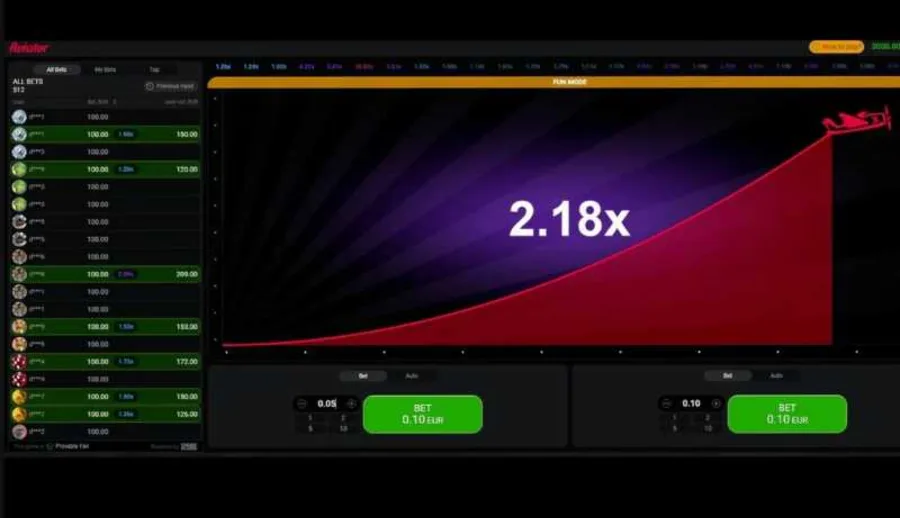
Target multipliers, odds and expected value
The table below is the one every serious player should internalize before touching a strategy. Probabilities use the 0.97/m rule; the expected value assumes the 97% model. Some operators run lower configurations, which only makes these numbers slightly worse, never better.
| Target multiplier | Chance of reaching it | Wins per 100 rounds | Expected value per $1 |
|---|---|---|---|
| 1.20x | 80.8% | ~81 | -$0.03 |
| 2.00x | 48.5% | ~49 | -$0.03 |
| 5.00x | 19.4% | ~19 | -$0.03 |
| 10.0x | 9.7% | ~10 | -$0.03 |
| 100x | 0.97% | ~1 | -$0.03 |
One more distribution fact worth carrying around: across the demo data and the provider's own model, roughly 52% of rounds crash below 1.5x, about 25% land between 1.5x and 5x, and only around 23% fly past 5x. Near-instant 1.00x crashes, where everyone loses, hit about one round in 33.
Short sessions are all variance; the edge only shows itself over thousands of rounds.
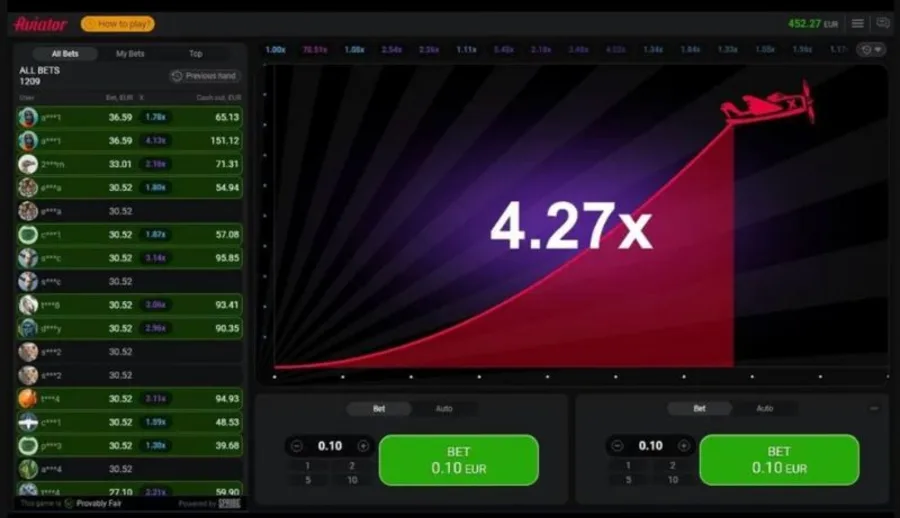
The strategies people actually use
None of these change the table above. What they change is your ride: how choppy it feels, how long a bankroll lasts, how big a swing you expose yourself to. That's a real thing to tune, so here's each method with its honest trade-off.
The two-bet hedge
Aviator lets you run two bets in one round. The common setup is a "safety" bet on a low auto-cash-out, around 1.3x to 1.5x, plus a second bet you let ride for a bigger number. The safety leg covers most of your stake when it lands, so the risky leg feels free. It isn't. You're just splitting the same negative-EV bet into two, and on a fast 1.00x round both legs die together. Useful for smoothing variance, worthless as an edge.
Low auto-cash-out grinding
Set an auto-cash-out at 1.2x to 1.5x and let it run. You'll win the clear majority of rounds, which feels like a system working. The catch is the losses: one 1.00x crash wipes several small wins, and they arrive in ugly clusters. My demo balance climbed for 20 rounds on a 1.3x auto, then gave it all back in four. Low-and-steady is the calmest way to play, not a profitable one.
Flat staking
Bet the same small amount every round, no chasing. Boring, and easily the most sensible option on this list. It won't turn a profit, but it makes your money last the longest for a given amount of play, which is the only "win" the math actually offers.
High-multiplier hunting
Chase 20x, 100x, higher. You'll lose most rounds by a mile, then very occasionally hit something that feels enormous. It's the highest-variance way to play and the fastest way to empty a bankroll if the big one is slow to come. Some players love it for the rush. Just size the stake tiny, because you're buying lottery tickets.
Martingale, and why it busts
Double your bet after every loss so one win recovers everything, then repeat. On paper it's tidy. In practice a finite bankroll and a table limit kill it. Start at $1 and a losing streak runs $1, $2, $4, $8, $16, $32, $64, $128 - eight losses and you're staking $128 to claw back $1, having risked $255 already. Aviator throws sub-1.5x rounds more than half the time, so a run like that isn't rare, it's Tuesday.
The reverse trap
Some flip it: raise stakes after wins to "ride hot streaks." There are no streaks. Every round is a fresh, cryptographically independent draw, so a win tells you nothing about the next crash. Ramping up after a couple of green rounds just means your biggest bet meets the inevitable 1.00x at the worst possible moment. I've watched a demo balance triple and then vanish inside three rounds doing exactly this.
Bankroll rules that genuinely help
Here's the part that actually matters, since none of the betting patterns move the odds. Discipline is the only lever with a real effect, and it's unglamorous.
Slow is the only speed the math rewards.
Stake 1-2% a round
Keep each bet to a small slice of your session money. On a $100 session that's $1 to $2 a round. It won't feel exciting, but it's the difference between a long evening and a five-minute one, and it keeps a single cold streak from ending things.
Set a stop-loss and a walk-away win
Decide before you start what loss ends the session and what win banks it. Then obey both. The game's 8-to-30-second rounds are designed to keep you tapping, and honestly, the speed is the real hazard here, not the odds.
Practice in the demo first
The free version uses the same 97% model and the same crash distribution, so it's a genuine rehearsal. Feel the variance on play money before it's your own. Our Aviator demo guide covers what the free mode does and doesn't include.
Treat it as paid entertainment
Assume the 3% edge will collect over time and budget the way you'd budget a night out. If you're playing to make money, the math is quietly against you every single round.
Predictors, signals and "hacks" are a trap
This needs saying plainly because the search results are full of it. No predictor app, Telegram signal group or "hack" can tell you where the plane will crash. Aviator is provably fair, which means each round's crash point is locked by a server seed, three client seeds and a round number, hashed and committed before betting even opens. The result can be verified after the round. It cannot be read in advance. That's not marketing, it's how the cryptography works.
So anything promising 95% accurate predictions is selling you a result that is mathematically unknowable. Worse, the tools are dangerous: security reporting has found that around 60% of "Aviator predictor" APK files carry malware, from info-stealers to crypto-clippers that quietly swap wallet addresses. I won't link any of them, and you shouldn't install one. If a video or channel is pushing a predictor, it's an ad for a scam, full stop.
Save your money and your phone.
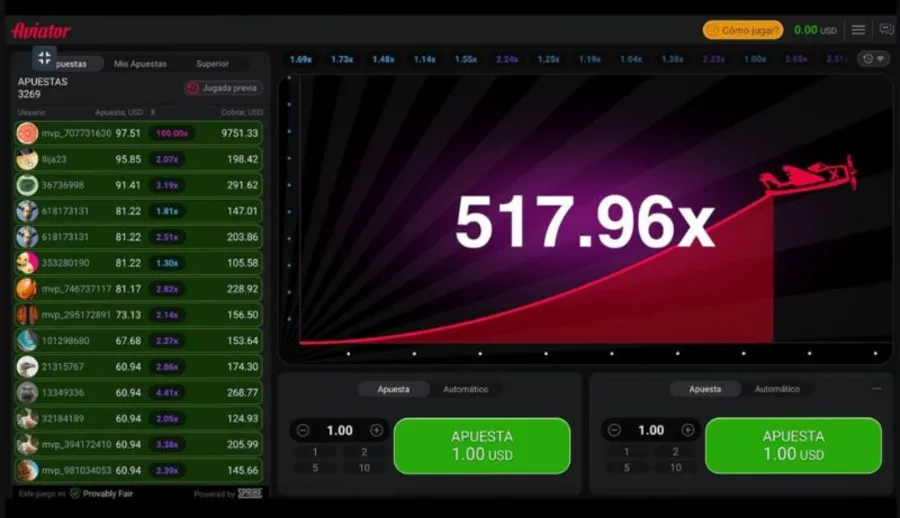
Where players go wrong
The strategies aren't the problem so much as the beliefs stacked on top of them. A few honest watch-outs from testing and from watching the live bet feed for hours.
Reading patterns that aren't there
"It's due for a big one after all these low crashes." No. Independence means the past 30 rounds carry zero information about the next. The near-miss feeling, watching the curve sail past your target then crash, is a powerful illusion of a pattern, and it's engineered to keep you playing.
Confusing "fair" with "winnable"
Provably fair proves the game isn't rigged against you beyond the stated edge. It does not mean you'll come out ahead. Those are different claims, and the marketing blurs them on purpose.
Letting the pace drive the stakes
Fast rounds plus the two-bet panel make it easy to creep your stake up without noticing. Set your bet size before you sit down, and change it deliberately or not at all.
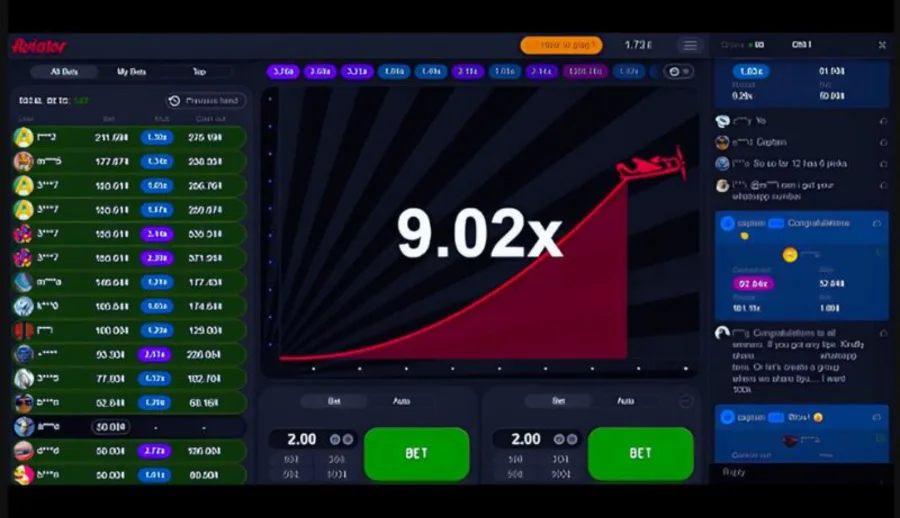
The honest bottom line
Use a strategy to decide how you want to lose, slowly and calmly or fast and swingy, and you're using it correctly. Use one because a video promised profit, and you've misunderstood the game. My advice after all those demo sessions is dull and true: pick flat or low-multiplier play, cap your stake at 1-2% a round, set hard limits, and enjoy it as a game rather than an income plan. If you want the deeper mechanics, the Aviator FAQ answers the common questions, and the player reviews collect what regulars actually make of it.